


| Date Created | Date 1st Review Due | Date Reviewed | Version | Next Review Due |
| March 2023 | March 2024 | |||
| September 2023 | 2 | September 2024 | ||
| September 2024 | 3 | September 2025 | ||
| September 2025 | 4 | September 2026 | ||
| August 2026 | 5 | September 2026 |
Egham Park School is committed to safeguarding and promoting the welfare of children and requires all staff to always act in the best interests of our children.
This policy refers to mobile phones, smartwatches, tablets, iPads, Chromebooks, laptops and all similar devices
1. Introduction
Egham Park School acknowledges the educational, social and entertainment benefits that the internet, mobile phones, computers, laptops, tablets, games consoles and other technologies offer.
We recognise our duty under the Education Act 2002 to make arrangements to ensure that functions are carried out with a view to safeguarding and promoting the welfare of children and comply with The Education (Independent School Standards) Regulations 2014 (updated 2019).
Egham Park School acknowledges the obligations associated with the UN Convention on the Rights of the Child (UNCRC), the Children Act 1989, the Human Rights Act 1998 and the Equality Act 2010.
We also follow current DfE guidance, ‘Keeping children safe in Education’ (2026), ‘Working together to safeguard children’ (2026), HM Government advice ‘What to do if you’re worried a child is being abused’ (2015) and the Local Safeguarding Children Partnership’s policies, procedures, guidance and protocols.
The breadth of issues classified within online safety is considerable and ever evolving, but can be categorised into three areas of risk:
There are 4 types of online safety risks outlined in KCSIE:
CONTENT: being exposed to illegal, inappropriate, or harmful content, for example: pornography, racism, misogyny, self-harm, suicide, antisemitism, radicalisation, extremism, extreme sexual or physical violence, misinformation, disinformation (including fake news) and conspiracy theories,
CONTACT: being subjected to harmful online interaction with other users or generative AI applications that simulate this; for example: peer to peer pressure, commercial advertising and adults posing as children or young adults with the intention to groom or exploit them for sexual, criminal, financial or other purposes,
CONDUCT: online behaviour that increases the likelihood of, or causes, harm; for example, making, sending and receiving explicit images, including those generated using AI and online bullying, and
COMMERCE: risks such as online gambling, inappropriate advertising, phishing and or financial scams.
It is the responsibility of all staff to understand the above, recognise when a child may be experiencing harm related to the above and report to the DSL.
Online safety forms a fundamental part of our safeguarding and child protection measures, and we will ensure that the appropriate action is taken immediately, where we believe a child may be at risk from content, contact, conduct or commerce. Our primary concern, at all times, is the welfare and safety of all members of Egham Park Schools community including children, staff and visitors.
We also have a key role to play in providing online safety education and (pastoral) support to children and identifying those who lack the skills, knowledge, confidence and resilience necessary to keep themselves safe online in and out of Egham Park School, so that children who need extra help receive it either in the school or through referral to other services.
This policy and all associated procedures apply to all staff, Egham Park School’s Leadership Team, volunteers, students on placement and any other individual working for, or on behalf of Egham Park School including outside agency workers, children and visitors and should be read in conjunction with other safeguarding and employment policies including (not an exhaustive list):
- Administration of Medication Policy
- Anti-Bullying Policy
- Behaviour Policy
- Child Protection Policy & Safeguarding Policy
- Compliments and Complaints Policy
- Curriculum Policy
- Drugs, Alcohol and Tobacco Policy
- Equality and Diversity Policy
- Exclusion Policy
- Grievance Procedure
- Health and Safety Policy
- Management of Behaviour: Rewards and Sanctions Policy
- Safer Recruitment Policy
- Self-Harm and Suicide Policy
- Whistle Blowing Policy
Failure to comply with these policies and procedures may result in disciplinary action, which might include summary dismissal (and, where appropriate, referral to the Disclosure and Barring Service and the Teacher Regulation Agency (TRA)) or termination of agreement or contract.
2. Roles and responsibilities
The Designated Safeguarding Lead will do all that they reasonably can to limit children’s exposure to the above risks from Egham Park School IT systems. As part of this process, Students are safeguarded from accessing inappropriate material using our Smoothwall Web Filtering and Firewall SI Security Appliances. The Designated Safeguarding Lead will regularly review the effectiveness of the filtering monitoring system when required, at least annually, following guidance set out in DfE Filtering and monitoring standards for schools & colleges (2023) and share any updates with the School Advisory Board.
The proprietor will also ensure that Egham Park Schools Leadership Team and other relevant staff:
• have an awareness and understanding of the provisions in place.
• manage them effectively; and
• know how to escalate concerns when identified.
3. Education and training
Whilst regulation and technical solutions are very important, their use must be balanced by
educating children to take a responsible approach. The education of children in online safety and digital literacy is therefore an essential part of our online safety provision.
The Education for a Connected World framework (2020) describes the digital knowledge and skills that children and young people should have the opportunity to develop at different ages and stages of their lives. It highlights what a child should know in terms of current online technology, its influence on behaviour and development, and what skills they need to be able to navigate it.
A key aspect of our approach is to help children learn to manage their own digital footprint,
including how to:
• use privacy settings to maintain some control over who they are sharing with.
• block people with whom they are not comfortable communicating or sharing with.
• remove content they have shared online; and
• report content which other people have posted to get it taken down.
In addition, we explore themes such as pornography, consent and the characteristics of healthy and unhealthy relationships, as appropriate, through the Computing, PSHE, Social Skills and Sex and Relationships Education curriculums.
Clear boundaries are set for the appropriate use of the internet and digital communications and are discussed with children and staff. Children are given the opportunity to explore and discuss online safety issues to build a resilience that equips them to manage their own online safety both in and out of Egham Park School. Positive and responsible technology use is recognised and rewarded.
Whenever overseeing the use of technology in school, all staff will encourage sensible use, monitor what pupils are doing and consider potential risks and the age appropriateness of tasks. This includes supporting them with search skills, reporting and accessing help, critical thinking (e.g. bias, disinformation, misinformation, and conspiracy theories), access to age-appropriate materials and signposting, and legal issues such as copyright and data law. The London Grid for Learning Trust (saferesources.lgfl.net) has regularly updated theme-based resources, materials and signposting for teachers and parents.
We utilise data from our safeguarding reports, filtering logs, monitoring captures, parental complaints and other feedback to inform our curriculum, so that we are constantly learning from concerns and being reflective and responsive to the needs of our children.
We recognise that nationally, children with SEND are less likely to receive effective online safety teaching, but are more at risk of being a victim of harm caused online. Therefore, at Egham Park School, we will ensure that we adapt our curriculum and teaching of online safety for all children. We will also consider whether specific filtering policies are required for particular children to afford more protection from online harms. We will also consider targeted and individual interventions that children need to protect them from harm and prevent future online harm.
4. Data protection
Personal data will be recorded, processed, transferred and made available in accordance with the General Data Protection Regulation (GDPR) and Data Protection Act 2018. For further information, see Egham Park School’s Data Protection Policy.
5. Harmful content online
Children can come across all sorts of harmful content online, examples of which are outlined in the introduction above. Children can come across it by accident, be shown by a friend or family member or they can deliberately search it out.
At Egham Park School we offer direct support to children who have viewed harmful content based, not only on the nature of the incident, but the child’s age, experience, strengths, vulnerabilities and circumstances.
In addition, we will ensure that children:
• have the opportunity and feel supported to air their views and explore sensitive issues, in a safe and secure environment.
• are supported to explore and manage risks and manage difficult situations online.
• are supported to report and take down content, including helping them to contact providers and/or third parties.
• are aware that what is presented to them online maybe biased, inaccurate, manipulated or misleading and they should consider where the information/images are coming from.
• have access to emotional and psychological support; and
• know where they can go to access advice, guidance, support and resources in relation to online matters including Childline.
5.1 Online pornography
Legal adult pornography is readily available online. Many teenagers will at some point seek out pornography because of adolescent curiosity and most are unlikely to suffer any long-term negative effects.
However, there is growing concern that children who routinely access pornography are at an increased risk of:
• normalisation of extreme or risky sexual acts, making them more likely to engage in harmful sexual activity.
Digital resilience refers to the emotional resources needed to (1) understand when you are at risk online (2) know what to do to seek help (3) learn from experience (4) recover when things go wrong. Risk and resilience are interrelated, as resilience can only develop through experience of risk and stressful events.
- developing discriminatory attitudes, perceiving people (particularly girls and women) as sex objects, rather than caring partners.
- struggling to engage in or enjoy real-life relationships or sexual activity, as pornography has created unrealistic expectations.
- an unhealthy preoccupation with sex, which can interfere with other aspects of their lives.
For more information and advice visit:
- Internet Matters – Online pornography resources
- Childnet International – Online Pornography
- NSPCC – Online porn
5.2 Violent content and gaming
Some adult games, especially those which involve players talking to others can expose children to scenes that:
• feature extreme violence, warfare and criminal activity.
• show explicit sexual acts, which may glamorise rape and assault.
• use racist, homophobic or sexist language and feature swearing.
• depict certain groups, such as women, in derogatory ways.
Although parents and professionals will have a view on whether a child is mature enough to play these games, children can be upset or start to normalise violent and aggressive behaviour and/or adopt beliefs associated with the character or game they play.
It is also important to remember that children can be groomed or bullied through games and introduced to other content and platforms. In extreme cases, some children experience gaming addiction.
For more information and advice visit:
- Childnet International – Gaming
- Internet Matters – Online gaming – The risks
- NSPCC – Online games
5.3 Self harm and pro-suicide sites
There are many apps, websites, forums and online chatrooms that work to support children’s mental health. However, there are blogs, forums and websites that can reinforce harmful offline behaviours and encourage self-harm and promote suicide.
The reasons children visit sites like these can be complex, often indicating broader emotional and well-being issues.
5.4 Eating disorder sites
The terms “pro-anorexia”, or “pro-ana”, and “pro-bulimia”, or “pro-mia”, refer to content, usually online, that promotes the harmful behaviour and mindset that forms part of some eating disorders.
The sites and social media where such content is found often say or imply that this behaviour is a lifestyle choice, rather than symptoms of an illness.
There is an assumption that people who post pro-ana, pro-mia, or “thinspiration” content are being deliberately malicious, are fully aware that they are misrepresenting symptoms as lifestyle choices and consciously want to encourage people to develop or continue to have eating disorders. But this is often not the case, as many of the people who post this content are suffering from eating disorders themselves.
5.5 Radicalisation and extremism
The school has obligations relating to radicalisation and all forms of extremism under the Prevent Duty. Staff must not support or promote extremist organisations, messages or individuals, give them a voice or browse, download or send material that is considered offensive or of an extremist nature. We ask for parents’ support in this also, especially relating to social media, where extremism and hate speech can be easily accessed and highly prevalent on mainstream platforms.
Extremist groups often target children via the internet and social media. Groups can easily share propaganda via online platforms like Facebook, YouTube, Instagram and Tik-Tok.
Online radicalisation and extremism can pose a significant threat to the well-being and safety of children, which may involve:
• being groomed online or in person.
• exposure to violent/upsetting material and other inappropriate information.
• psychological manipulation.
• isolation from friends and family.
• sexual and commercial exploitation.
• encouraging children to act in a way that puts them at risk of physical harm or death.
Egham Park School’s acknowledges its duty under section 26 of the Counter-Terrorism and Security Act 2015, (the CTSA 2015) to have “due regard to the need to prevent people from being drawn into terrorism”.
This duty is known as the Prevent duty.
In meeting our obligations, we:
• assess the risk of children being drawn into terrorism, including support for extremist ideas that are part of terrorist ideology.
• protect children from being drawn into terrorism, by having robust safeguarding policies in place to identify children at risk, and intervene, as appropriate.
• teach a broad and balanced curriculum which promotes the spiritual, moral, cultural, mental and physical development of children and prepares them for the opportunities, responsibilities and experiences of life. We also place a strong emphasis on the fundamental British values of democracy, the rule of law, individual liberty and mutual respect and tolerance of those with different faiths and beliefs.
• ensure children are safe from terrorist and extremist material when accessing the internet on our site, including by establishing appropriate levels of filtering and monitoring following guidance set out in DfE Filtering and monitoring standards for schools & colleges (2023)
Identification, assessment and management of such risks form an integral part of Egham Park School’s referral and admissions procedures, and any concerns would be recorded and addressed, in accordance with national and local guidance.
For further information, see our ‘Child Protection & Safeguarding Policy’.
For more information and advice visit:
- Internet Matters – Tackling radicalisation facts & advice.
- Educate Against Hate This website provides practical advice, support and resources to protect children from extremism and radicalisation.
6. Harmful contact online
6.1 Online grooming and sexual abuse
Sexual grooming is a process through which an offender seeks to build trust with a child for the purpose of sexually abusing them. Grooming can be facilitated by technology and most instances of grooming now contain an online component.
Offenders build and exploit a trusting relationship with the child and use that trust to exercise manipulation, coercion and control.
The following examples illustrate the range of techniques offenders use (not an exhaustive list):
• Bribery – offering rewards and gifts
• Emotional blackmail
• Flattery
• Offering and providing emotional support
• Persistent pressure
• Pretending it is a game such as truth or dare
• Pretending to be someone they are not, such as another child
• Threats
Even though a child may never meet the offender face-to-face, children forced, tricked or persuaded to participate in online abuse may be left with long-term trauma from the experience and can suffer just as much harm as those abused by an offender in the ‘offline’ world.
If you become aware of a situation in which a child may have been groomed and/or sexually abused online you must inform Amar Panesar, Designated Safeguarding Lead (DSL), or another Designated Person as a matter of utmost urgency.
For more information and advice visit:
- Childline – Online grooming
- Childnet International – Online grooming
- Internet Matters – Deal with it
6.2 Online bullying
Online bullying (sometimes called cyberbullying) is bullying that happens online via apps, online games, social networks, websites and photo, text and video messaging. It can happen when using any device and takes many forms:
• abusive or threatening texts, emails or messages
• posting abusive comments on social media sites
• modifying and/or sharing humiliating videos or photos of someone else
• stealing someone’s online identity
• spreading rumours online
• trolling – sending someone menacing or upsetting messages through social networks, chatrooms or games.
• developing hate sites about another person
• prank calls or messages,
• group bullying or exclusion online
• anonymous messaging
• encouraging a child to self-harm
Anonymous bullying
Sometimes children can hide their identity when they are online using apps and/or sites This enables them to send messages to others completely anonymously. Anonymous bullying can include posting offensive comments on someone’s profile or sharing negative thoughts.
The impact of being bullied anonymously by someone unknown to you can be severe. Children can feel emotionally vulnerable, paranoid and anxious, as they are unaware who the bully is and when they might strike again.
In supporting a child who is experiencing anonymous bullying you should:
• offer emotional support and encourage them not to retaliate.
• show them how to block users on websites and apps.
• encourage them to save the evidence by taking screen shots, printing things off and keeping a record of dates, times and so on.
• discuss what is and what is not acceptable online.
• encourage them to report the bullying to their parents and service providers.
Online bullying is wholly unacceptable and will not be tolerated at Egham Park School.
All incidents will be addressed in accordance with Egham Park School’s Anti-Bullying Policy.
For more information and advice visit:
- Childnet International – Cyberbullying
- Internet Matters Cyberbullying facts & advice
- NSPCC – Bullying and cyberbullying
7. Harmful conduct online
Many children share personal content online including:
• photos and videos of themselves, their friends and things they like
• videos and live streams of themselves talking to camera, performing or gaming
• blogs
• comments on their own and other people’s uploaded content
7.1 Youth produced sexual imagery
Youth produced sexual imagery is when children share sexual images that they or another child have created themselves. Adults sometimes refer to this as sexting which can include sending sexually suggestive comments. However, children use many other terms for this behaviour such as nudes, which includes semi-nude images. It is important to remember this when talking to children.
There are many reasons why a child might share a nude image or video. Some situations are riskier than others.
Across the UK it is illegal for anyone, including a child, to make, possess or share an indecent image of someone under 18 years of age.
If a child has been pressured, manipulated or coerced into sharing an explicit image of themselves and/or you become aware of a situation in which a child has shared a youth-produced sexual image with an adult you must inform Amar Panesar, Designated Safeguarding Lead, or another Designated Person as a matter of utmost urgency.
Everyone must understand that whilst the sharing of intimate or sexual images involving children (created via AI or otherwise) is illegal, pupils should be encouraged and supported to talk to members of staff if they have made a mistake or had a problem in this area. The UKCIS guidance seeks to avoid unnecessary criminalisation of children. The school DSL will use the full guidance document, Sharing Nudes and Semi-Nudes – Advice For Educational Settings to decide next steps and whether other agencies need to be involved (see flow chart below from the UKCIS guidance) and next steps regarding liaising with parents and supporting pupils. The school will also make use of guidance from The Marie Collins Foundation with regards to supporting victims of Technology Assisted Child Sexual Abuse.
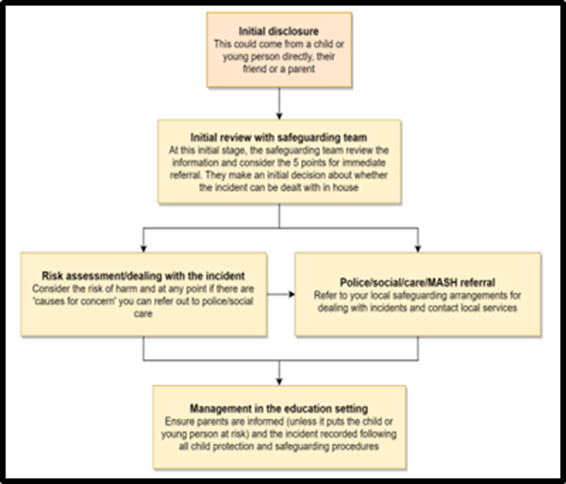
Be aware that if a child has been groomed, they may not realise they are being abused.
Everyone must understand that upskirting (taking a photo or video of someone under their clothing, not necessarily a skirt) is a criminal offence and constitutes a form of sexual harassment, as highlighted in Keeping Children Safe in Education. As with other forms of child-on-child abuse, pupils can come and talk to members of staff if they have made a mistake or had a problem in this area. Upskirting has become more prevalent due to the increased use of smart glasses and other discreet recording technology that can capture imagery without individuals knowing.
For further information and advice see:
Department for Digital, Culture, Media & Sport and UK Council for Internet Safety (2020) ‘Sharing nudes and semi-nudes:
- Advice for education settings working with children and young people
- Childnet International – Sexting
- Internet Matters – Dealing with sexting
- NSPCC – Sexting and sending nudes
8. Safe use of digital images
The term “images” refers to photographs (digital and film), ‘video’, DVD and webcam recordings.
Staff and children need to be aware of the risks and pressures associated with sharing images and publishing digital images on the internet. Such images may provide avenues for online bullying to take place.
Digital images may remain available on the internet forever and may cause harm or
embarrassment to individuals in the short or longer term. It is common for employers to carry out internet searches for information about potential and existing employees.
Egham Park School will inform and educate users about these risks and pressures and will implement policies to reduce the likelihood of any potential for harm.
• Images published on our website, in our brochure, newsletter, or elsewhere, including those released to local and national media, do not include children. Staff will be selected carefully and will comply with good practice guidance on the use of such images.
• Written permission from the child, their parents, carers or other responsible adult (e.g., social worker) must be obtained before images of children (and positive examples of their work) are recorded or distributed in any form. Written permission must also be obtained from staff, as appropriate.
• Where a child does not have capacity to give consent, parents and carers cannot give consent. If an image of a child is to be used without their consent, there must be evidence to show that it was in the best interest of the child.
• Original signed consent forms for children and staff must be stored securely in their personal files.
• Children must be asked if they are happy (if they consent) for their image to be recorded each and every time a photograph or ‘video’ is to be created. Children should be informed that they can choose whether or not to have their image recorded, how much or little they would like particular images to be shared; and they can change their mind at any time before, during or after the images have been taken.
• Similarly, you must get the permission of anyone in an image, including staff or those who are not part of a crowd and easily recognisable.
• Egham Park School staff must only use company equipment to take or store images of children. Unless the Headteacher has given written permission for personal equipment to be used for setting-related purposes. A senior member of staff must be informed when personal equipment is being used each and every time and for what purpose.
• Care should be taken when taking digital/video images that children and staff are appropriately dressed and are not participating in activities that might bring the individuals or Egham Park School into disrepute.
• It is the responsibility of those using images, to check that consent forms are current, and the child or member of staff is still in agreement. Senior staff must also check that there are no outstanding concerns or issues associated with the individual, which would make the use of their image inappropriate.
• All images created by staff in their capacity as an employee of Egham Park School remain the property of Egham Park School and copyright rests with Egham Park School.
• Images taken by authorised external photographers (see below) will be purchased outright as part of the package for unlimited use and thus remain the property of Egham Park School. Images taken by any child are the property of the child and relevant consents must be obtained before using the images.
• The hiring of authorised external photographers will be done through Egham Park School. All external photographers will be briefed on the nature of our business and will be obliged to abide by our safeguarding and child protection procedures. Any relevant checks will be conducted, in accordance with our Child Protection Policy.
• All images of children and staff must be stored securely on a password-protected device. Any sharing of images must comply with the General Data Protection Regulation (GDPR) and Data Protection Act 2018.
• Full names and/or personal details of children and staff will not be published anywhere on our website, in our brochure, newsletter or elsewhere, particularly in association with photographs.
• Given the potential for misuse, children are not permitted to use personal digital cameras or other photographic equipment without the express permission of the Headteacher.
• Photographs can be taken with the full knowledge and consent of the person concerned, but children must not use, share or distribute images of staff, children or visitors under any circumstances.
• When using digital images, staff should inform and educate children about the risks associated with the taking, use, sharing, publication and distribution of images.
• In accordance with guidance from the Information Commissioner’s Office, parents/carers are, with the SLT’s, Headteacher’s or Proprietor’s permission, welcome to take videos and digital images of their children at Egham Park School’s events for their own personal use (as such use in not covered by the Data Protection Act). To respect everyone’s privacy and in some cases protection, these images should not be published/made publicly available on social networking sites, nor should parents/carers comment on any activities involving other children in the digital/video images. The SLT, Headteacher or Proprietor reserves the right to ask parents not to take pictures or films if there are children within the proximately without photo/video consent.
• We have CCTV installed around the perimeter of our buildings for safeguarding and security reasons. Access to footage captured in this way is strictly limited to authorised members of staff. Images may be viewed by authorised agencies, including police and children’s social care, for the investigation of safeguarding concerns and/or criminal behaviour.
9. Reporting and recording online safety incidents
Egham Park School commits to taking all reasonable precautions to safeguard pupils online, but the internet can never be 100% safe (as stated in KCSIE), and we recognise that incidents will occur both inside school and outside school (and that those from outside school will continue to impact pupils when they come into school or during extended periods away from school).
Any inappropriate behaviour, associated with online safety and multi-media devices, (confirmed or otherwise) must be reported to senior staff and recorded, as soon as is reasonably possible (and normally within 24 hours of the incident). Our response to online safety and multi-media-related incidents always focuses on promoting and safeguarding the welfare of children, and any risks associated with children’s use of multimedia/electronic communication are documented and communicated to the adults who work with them.
Where appropriate, plans and help will be put in place to reduce the risk of harm or actual harm and there is evidence that these risks are being minimised.
If you have any concerns that a child’s behaviour may be associated with any of the following:
• child criminal exploitation (CCE), such as county lines
• child sexual exploitation (CSE)
• female genital mutilation (FGM)
• forced marriage
• involvement in gangs
• radicalisation and/or violent extremism
• peer on peer abuse, including sexual violence and sexual harassment
As per the Children’s Wellbeing and Schools Act (2026), there is now a mandatory duty for teachers to report any concerns of child sexual abuse, which includes sexual abuse that is facilitated by and/or takes place online (including non-contact abuse such as image sharing). Therefore, all staff must repot such concerns without delay to the DSL.
You must also immediately refer the matter to Amar Panesar, Designated Safeguarding Lead or another Designated Person, in accordance with our ‘Child Protection & Safeguarding Policy’. If they are not available, then you must report it to the Headteacher.
If you feel that there is an immediate danger to the life of the individual or others, then call 999.
The school will actively seek support from other agencies as needed (i.e. the local authority, LGfL, UK Safer Internet Centre’s Professionals’ Online Safety Helpline (POSH), NCA CEOP, Prevent Officer, Police, IWF and Harmful Sexual Behaviour Support Service).1
We will inform parents/carers of online safety incidents involving their children, Children’s Services and the Police where staff or pupils engage in or are subject to behaviour which we consider is particularly concerning or breaks the law.
10. Monitoring online safety incidents
Egham Park School has delegated responsibility for the regular monitoring and evaluation of online safety incidents on a daily, weekly and monthly basis to the Designated Safeguarding Lead. The information generated during this process is shared, as appropriate, with:
• Members of the Leadership Team.
• Teaching Staff.
• Egham Park School Safeguarding Team.
Online safety is also a standing item under ‘Safeguarding and Child Protection’ on all relevant staff meeting agendas.
11. Responding to incidents of misuse
Given the potential for huge diversity in the nature, circumstances, severity and degree of intent, associated with online safety and multi-media incidents, the definition of prescribed responses in this policy document is considered inappropriate.
However, since many incidents of misuse will reflect situations in the off-line world, they will be addressed in accordance with the aims, principles and practice outlined in one or more of the other safeguarding, behaviour and employment policies.
12. Behaviour support plans and risk assessments
Where a child has been involved in an online safety or multi-media incident, new information will be recorded, as appropriate.
Relevant information will be communicated to other staff, as soon as reasonably possible, and the individual risk assessment and/or behaviour support plan will normally be reviewed and redistributed (where appropriate) within 72 hours.
All relevant staff are obliged to familiarise themselves with the current risk assessment and behaviour support plan, for every child they are likely to have responsibility for educating, engaging, supporting or supervising.
13. Mobile Phone Policy
The purpose of mobile phone policy and/or multi-media is to provide children with a clear and concise summary of our expectations, and to describe, where appropriate, the potential consequences of any breach.
14. Device usage including personal devices such as wearable technology and bring your own device (BYOD)
Pupils
Our approach to pupils using mobile phones is in line with the DfE Guidance.
· Important messages and phone calls to or from parents can be made at the school office, which will also pass on messages from parents to pupils in emergencies.
· Personal recording devices, such as smart glasses, are not permitted in school without written permission. It is forbidden to take secret photos, videos or recordings of teachers or pupils, including remotely, with any device.
All staff who work directly with children including volunteers
· Staff working directly with children should keep their mobile phone in their personal locker, switched off or on silent, and only use them in private staff areas during school hours. If a staff member is expecting an important personal call when teaching or otherwise on duty, they may leave their phone with the school office to answer on their behalf or ask for the message to be left with the school office.
· Other personal recording devices such as smart glasses are not permitted in school without written permission. It is forbidden to take secret photos, videos or recordings of teachers or pupils, including remotely, with any device.
- If a pupil requires a mobile phone or device to help manage a medical condition, this will be outlined in their individual plan, which will outline the purpose, length and time of use required. The device or phone must be on the school wifi, on silent and used when an adult is present with them. This should be discussed and agreed with parents and SLT.
- If a staff member requires a mobile phone or device to help manage a medical condition, this will be outlined in their individual plan, which will outline the purpose, length and time of use required. The device or phone must be on the school wifi, on silent and used when an adult is present with them. This should be discussed and agreed with SLT.
Outside agencies and Advisory Board
· Visitors to the school from outside agencies and the school Advisory Board should leave their phones in their pockets and turned off. Under no circumstances should they be used in the presence of children or to take photographs or videos. If this is required (e.g. for contractors to take photos of equipment or buildings), permission of the headteacher should be sought (the headteacher may choose to delegate this) and this should be done in the presence of a member of staff.
· Other personal recording devices, such as smart glasses are not permitted in school without written permission. It is forbidden to take secret photos, videos or recordings of teachers or pupils, including remotely, with any device.
Parents
· They should ask permission before taking any photos, e.g. of displays in corridors or classrooms, and avoid capturing other children.
· Parents are asked not to call pupils on their mobile phones during the school day as they will not have their phone on them; urgent messages to be passed via the school office.
· We do not allow Apple AirTags or similar devices in school. Please note that it is against the terms and conditions of these products to use them to track a child.
· It is forbidden to take secret photos, videos or recordings of teachers or pupils, including remotely, with any device. Other personal recording devices such as smart glasses are not permitted in school without written permission.
15. Seeking the views of children, parents, carers, local authorities and staff
Regular enquires are made of all children as to how safe they feel at Egham Park School and ways in which services and outcomes can be improved. The views of parents, carers, local authorities and staff are also sought through existing mechanisms for consultation and feedback. Records are kept of these enquiries and any actions taken.
16. Safeguarding and child protection
Access to the internet via Egham Park School’s hardware will only be provided on a high adult-to-child ratio, under the supervision of staff who have undertaken safeguarding, child protection and online safety training.
We currently use a ‘locked down’ system, which means inaccessible sites may only be opened upon request from staff or children for legitimate reasons. The Designated Safeguarding Lead has full responsibility for the filtering and monitoring system and any request must be made directly to them.
Egham Park School will always consider whether a child’s behaviour gives cause to suspect that they are suffering, or are likely to suffer, significant harm; or whether their behaviour might be the result of unmet educational or other needs.
All child protection concerns will be addressed in accordance with our ‘Child Protection & Safeguarding Policy’.
17. Online safety outside of Egham Park School’s premises
A decision whether or not to intervene in online safety incidents outside of our premises will be made by the Headteacher and Designated Safeguarding Lead.
18. Police involvement
Careful, child-centred decision-making is made about reporting their behaviour to the police, though appropriate notifications are always made and clearly documented.
If the behaviour could be criminal or poses a serious threat to a member of the public, the police should always be informed.
When to call the police:
Guidance for schools and colleges should help senior staff understand when they should consider calling the police and what to expect when they do. If they are unsure then to ask the DSL or safeguarding team.
A decision whether or not to involve the police in an online safety incident will be made by the Headteacher.
19. Complaints
Children, staff, parents, carers, and any other adult with parental responsibility (e.g., social worker) or other local authority representatives are all able to complain to Egham Park School if they are unhappy with any aspect of the education or care provided.
All complaints are taken seriously and will be dealt with without delay. For further information, see our ‘Compliments and Complaints Policy’.
All complaints concerning allegations of child abuse will always be addressed in accordance with our ‘Child Protection & Safeguarding Policy’.
20. Implementation, monitoring, evaluation and review
The designated senior member of staff with overall responsibility for the implementation, monitoring and evaluation of the ‘Online safety and M6ulti-Media Policy’ is the Designated Safeguarding Lead.
The designated member of staff is also responsible for ensuring that all children, staff, parents, carers and placing local authorities are aware of our policy. Additional support would also be provided to any parent or significant person, wishing to know more about the policy and procedures outlined above.
A copy of this policy document is available for inspection on the premises during office hours (term time only).
The policy document will be reviewed and publicised in writing, at least annually and, if necessary, more frequently in response to any significant incidents or new developments in national, local and organisational policy, guidance and practice.
The Proprietor of Egham Park School, will also undertake an annual review of the school’s policies and procedures relating to safeguarding, and ensure that all duties have been discharged in accordance with current legislation, regulations and statutory guidance; as well as local authority procedures and practice, including the relevant Local Safeguarding Children Partnership(s).
The Proprietor stringently holds senior leaders to account for all aspects of the school’s performance through robust systems of governance, reporting and monitoring.
FEEDBACK
If you have any comments, questions, concerns or suggestions about the content of this policy document please speak to the Headteacher. Alternatively, you can contact the DSL- Amar Panesar, Egham Park School, 01784 913929, Apanesar@eghamparkschool.co.uk.
Further information about online safety
1.1. New opportunities and potential risks
Technology offers extraordinary opportunities for all of society – opportunities for learning, play communication, skill development, creativity and for having fun.
However, the use of these technologies can also put children at risk within and outside the setting. Some of the dangers they may face include:
• access to illegal, harmful or inappropriate images or other content.
• unauthorised access to/loss of/sharing of personal information.
• the risk of being ‘groomed’ or radicalised, by those with whom they make contact on the internet.
• the possibility of arranging to meet strangers.
• the sharing/distribution of personal images, without an individual’s consent or knowledge.
• inappropriate communication/contact with others, including strangers.
• the risk of engaging in sexually damaging conversations and video interactions.
• cyberbullying.
• access to unsuitable video/internet games.
• an inability to evaluate the quality, accuracy and relevance of information, on the internet.
• plagiarism and copyright infringement.
• illegal downloading of music or video files; and
• the potential for excessive use, which may impact on the social and emotional development and learning of the child.
Many of these risks reflect situations in the off-line world and it is essential that this policy document is used in conjunction with other relevant policies including Anti-Bullying, Child Protection and Equality and Diversity.
It is also important to acknowledge that the ‘probability of risk’ is based on a complex interaction between a child’s age, experience, strengths, vulnerabilities and circumstances and the properties of the specific technology.
As with all risks, it is impossible to eliminate online safety risks completely; and that is why it is essential, to develop children’s risk identification, assessment and management skills, so that they have the confidence and resilience to deal with such risks, if and when they arise.
Roles and responsibilities
2.1. Headteacher
The Headteacher has a duty of care for ensuring the safety (including online safety) of all members of Egham Park School community, though day to day responsibility for online safety will be delegated to The Designated Safeguarding Lead.
The role of the Headteacher is to:
• ensure that Egham Park School’s network is as safe and secure as is reasonably possible and that the approved policies and procedures are implemented.
• ensure that children are safe from illegal, inappropriate or harmful content when accessing the internet on our site, including by establishing appropriate levels of filtering, such that ‘over blocking’ does not lead to unreasonable restrictions as to what children can be taught with regard to online teaching and safeguarding.
• ensure that all staff have access to, are aware of and follow Egham Park School’s Online Safety and Multimedia Policy.
• ensure that the DSL and all other relevant staff receive suitable training, in accordance with their roles and responsibilities.
• liaise with the DSL on a regular basis, providing guidance and support, as appropriate.
• support the DSL in managing serious online safety and multi-media incidents/allegations involving staff and children.
• monitor, analyse and report on the levels and frequency of online safety and multi-media incidents to Egham Park School’s Safeguarding Team and other interested parties, as appropriate.
• notify Egham Park School’s Safeguarding Lead about ALL child protection concerns that warrant discussion with parents, carers or an external agency/professional, including the local multiagency safeguarding hub (or equivalent), Designated Officer, police or children’s social care including the allocated social worker; within 24 hours of the concern being reported; and record all relevant information on CPOMS.
• maintain a record of all cause for concern issues and child protection concerns.
The Designated Safeguarding Lead (DSL) and other staff at Egham Park School, have also attended training in online safety and is aware of the potential for serious child protection issues to arise from:
• sharing of personal data.
• access to illegal/inappropriate materials.
• inappropriate on-line contact with adults/strangers.
• potential or actual incidents of grooming, exploitation and radicalisation.
• online bullying.
The Designated Safeguarding Lead (DSL) (and all other Designated Safeguarding Persons) are aware of the procedures to be followed in the event of a serious online safety allegation made against a member of staff.
2.2. Designated Safeguarding Lead
The senior member of staff with day-to-day responsibility for dealing with online safety issues is the DSL, Amar Panesar.
The role of the Online Safety Lead is to:
- ensure that all staff know and understand the procedures that need to be followed, in the event of an online safety/multi-media incident taking place.
- take a lead role in managing online safety/multi-media incidents involving staff and children, in accordance with policies, procedures and guidance.
- receive reports on online safety/multi-media incidents and create a log of such events to inform future policy, procedures and practice.
- monitor the levels and frequency of online safety/multi-media incidents and report these findings to the Leadership Team, on a monthly basis.
- provide advice, training and support to staff and children, as appropriate.
- manage the filtering & monitoring of all school software and ensure it remains effective and fit for purpose following guidance set out in ‘DfE Filtering and monitoring standards for schools & colleges (2023)’
- Update the school Advisory board on any updates made to the school Filtering and Monitoring System.
2.3. Network
• Egham Park School’s technical infrastructure is as secure as is reasonably possible and is not open to misuse or malicious attack.
• Users may only access Egham Park School’s network through a properly enforced password protection arrangement.
• Children are safe from illegal, inappropriate or harmful content when accessing the internet on our site, including by establishing appropriate levels of filtering and monitoring, such that ‘over-blocking’ does not lead to unreasonable restrictions as to what children can be taught with regard to online teaching and safeguarding. These filters are to be regularly reviewed by the Designated Safeguarding Lead and Advisory Board to ensure that they remain fit for purpose.
If an attempt is made to access inappropriate material through use of our Smooth wall Web Filtering and Firewall S1 Security Appliances. The forensic monitoring system will notify the IT provider who will then notify the DSL of the following:
• Device name or ID, IP address, and where possible, the individual
• The time and date of attempted access
• The search term or content being blocked
• The Filtering and monitoring systems are reviewed when required, at least annually by the Designated Safeguarding Lead and any updates shared with the Advisory Board.
Egham Park School does not accept responsibility for any loss or damage to any personal mobile phone or associated accessories, unless placed in the care of our staff.
3.2 ICT network and email
When joining Egham Park School, all children will be allocated a username and password for access to the ICT network (and email system), subject to risk assessment and agreement by parents, carers or another responsible adult (e.g., social worker)
3.3 Social networking websites and apps
Children are not permitted access to social networking websites or apps via the Egham Park School network.